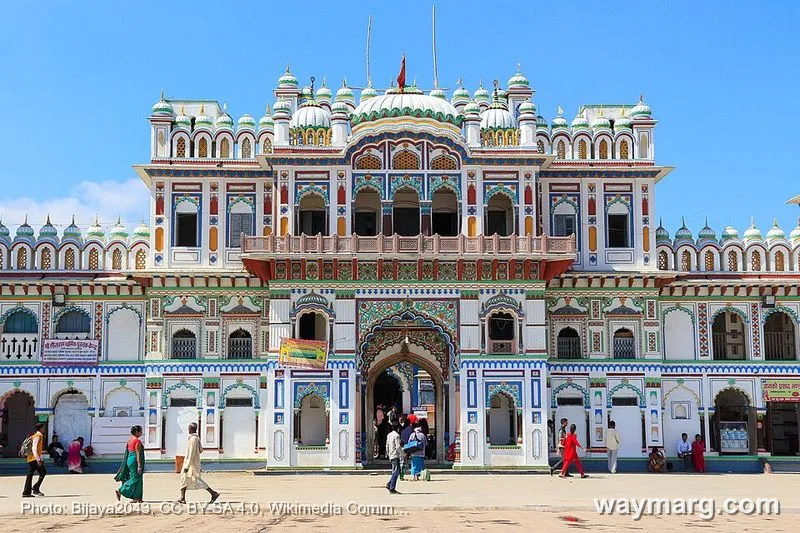
Janaki Mandir, Janakpur: Nepal's Claim to Sita's Birthplace and Wedding Site
The story begins with a king who wanted a daughter and a field he was plowing to prepare a yagna. King Janaka of Mithila was dragging a ceremonial plow through the earth -- some versions say searching for rain, others simply performing the ritual -- when the furrow turned up something that shouldn't have been there: an infant girl, lying in the broken soil as if the earth itself had delivered her. Janaka, childless and devout, lifted the child out and raised her as his own. He named her Sita, from the Sanskrit word for the furrow that held her.
That single scene is the hinge on which two modern towns, two countries, and this entire page turn. Janakpur, in Nepal's Madhesh Province, holds that the furrow was here, within the territory that was once Janaka's capital of Mithila -- and that the temple described on this page, Janaki Mandir, marks the ground where it happened. Sitamarhi, across the border in Bihar, holds the same story about its own field at Punaura Dham, a short drive from the town that is literally named for Sita. Neither claim is settled, and WayMarg does not adjudicate between them. Both are long-standing, sincerely held traditions rooted in the same Ramayana episode, maintained today by two different countries with two different temples. Our companion guide to Sitamarhi states the Indian side of the same hedge in almost the same words -- read both, and decide for yourself which tradition you find more persuasive, if either.
What is not in dispute is Mithila itself, and why it matters. In the Ramayana, Mithila -- also called Videha -- was an ancient kingdom in the eastern Gangetic plain, straddling what's now the Nepal-India border, ruled by a line of philosopher-kings known as the Janakas. It was a byword for a particular kind of rule: Janaka was a raja-rishi, a king who was also a sage, said to have debated philosophy with Vedic scholars as an equal. Sita growing up as his daughter in that court is part of why she enters the Ramayana already formidable -- not a passive figure waiting to be rescued, but a princess of a kingdom known for its learning. When Rama later arrived in Mithila as a young prince accompanying the sage Vishwamitra, it was to a court like that he came -- and it was there, at the Sita Swayamvara, that he won her hand by lifting and breaking Shiva's bow, a weapon no other suitor present could even move. The wedding that followed is what the temple's adjoining mandapa is traditionally linked to.
- Country: Nepal (Janakpurdham, Dhanusa District, Madhesh Province)
- Built: 1910-11 AD (1967 BS), funded by Queen Vrisha Bhanu of Tikamgarh (Orchha) at a reported cost of roughly nine lakh rupees -- hence "Nau Lakha Mandir"
- Architecture: Koiri/Hindu-Kushwaha style, Mughal-influenced white marble and stone
- Key festival: Vivaha Panchami, Rama and Sita's wedding anniversary (Nov/Dec, per the lunar calendar)
- Minimum time: 1.5-2 hours
- Suitable for: Pilgrims; pairs with a wider Mithila-region visit, including Sitamarhi across the border
A Queen's Temple, Built in Nine Lakh Rupees
Unlike most of the sites in this circuit, Janaki Mandir isn't an ancient structure with a disputed founding date -- it's a datable, documented building, just over a century old. It was constructed between 1910 and 1911 (1967 in the Bikram Sambat calendar used in Nepal), commissioned and funded by Queen Vrisha Bhanu of Tikamgarh, a princely state in what is now Madhya Pradesh, India (the state is also referred to in some sources by its older name, Orchha). Local tradition holds the construction cost at roughly nine lakh rupees -- nine hundred thousand -- which is the direct source of the temple's popular alternate name, Nau Lakha Mandir ("nine-lakh temple"). It stands today on, or very near, the site of an older, smaller shrine that had marked the spot for generations before the queen's much grander structure replaced it.
The result is a three-storied white structure built in a style the Nepali tradition calls Koiri or Hindu-Kushwaha architecture -- a form visibly shaped by Mughal design, with turrets, intricate latticed windows, domes, and more than a hint of a Rajasthani or Mughal palace rather than a typical North or South Indian temple silhouette. The interior and surrounding complex carry panels of Madhubani painting, the vividly colored folk-art tradition of the wider Mithila region, applied here as both decoration and a way of keeping that regional art form visibly tied to its most sacred local site. The adjoining Vivaha Mandap -- the wedding pavilion -- is the structure tradition identifies with the actual marriage of Rama and Sita, distinct from the main shrine itself but inseparable from the pilgrimage.
Vivaha Panchami: The Wedding, Re-Enacted
The temple's single biggest date on the calendar is Vivaha Panchami, the lunar-calendar anniversary of Rama and Sita's wedding, which typically falls in late November or December (Hindu month of Margashirsha). It is the one day of the year when Janakpur functions less like a town with a famous temple and more like the actual venue of a wedding still being celebrated: a formal baraat -- the groom's wedding procession -- is re-enacted as arriving from Ayodhya, complete with musicians, a ceremonial palanquin, and crowds that can run into the hundreds of thousands drawn from both Nepal and across the border in Bihar. Pilgrim buses and trains from the Indian side book out well in advance of the date, and Janakpur's limited hotel stock is stretched thin for several days around it. If you're planning a visit specifically to coincide with Vivaha Panchami, treat it the way you would any major single-day festival at a major shrine: book lodging months ahead, expect serious crowding at the temple itself, and budget extra time simply to move through the town.
Visiting Today
Janaki Mandir functions as an active, daily place of worship rather than a monument visited on a fixed schedule -- it's generally open from early morning to evening with a midday gap for ritual cleaning and private worship, so arriving early (by 7-8 AM) or in the late afternoon gives the most reliable access. The temple reportedly suffered minor structural damage in the April 2015 earthquake that struck Nepal; by all current accounts it has been repaired and remains fully open to visitors, but it's worth a quick check closer to your travel dates rather than assuming the building looks exactly as it does in older photographs. Modest dress is expected, as at any active Hindu shrine, and footwear is removed before entering the inner complex. The temple and its grounds are maintained by a local trust under the Nepal government's religious and cultural affairs administration, with day-to-day management historically overseen by priests from the Ramanandi sect.
When to Go
Outside of Vivaha Panchami, the cooler months from October through February are the most comfortable for visiting the Terai plains, avoiding both the pre-monsoon heat and the monsoon's flooding risk on local roads. Vivaha Panchami itself is the one date that will define your trip if you choose it: extraordinary atmosphere and a once-a-year re-enactment, in exchange for the heaviest crowds and tightest lodging of the year. For a calmer visit focused on the temple and architecture rather than the festival, a quiet weekday morning outside the Nov/Dec festival window is the better choice.
Getting There
Janakpur sits in Nepal's southern Terai plain, close enough to the India-Nepal border that most visitors arrive from the Indian side rather than from Kathmandu. The most direct current option is the Jaynagar-Janakpurdham broad-gauge railway, a cross-border passenger line that opened in April 2022 -- the first such rail link rebuilt between India and Nepal in decades -- connecting Jaynagar in Bihar (itself roughly 180 km from Patna) to Janakpurdham station in roughly half an hour to an hour depending on the service, crossing the open India-Nepal border by train rather than on foot. From the Nepali capital, Janakpur is reachable by a roughly 20-25 minute domestic flight from Kathmandu, or by a long full-day road journey of 8-10 hours along the Terai highway -- the flight is strongly preferable unless you're already overlanding through the region. Because Janakpur and Sitamarhi sit on opposite sides of the same open border and roughly the same historic Mithila territory, a visitor without a strict single-country itinerary can reasonably combine both sites into one regional trip, crossing at Jaynagar or one of the other nearby border points; just confirm current visa and border-crossing requirements for your nationality before planning that combination, since rules for third-country nationals differ from those for Indian and Nepali citizens.
Ready to plan your trip?
Build a day-by-day itinerary with WayMarg — explore routes, nearby food and stays, collaborate with family, and export your trip. No sign-up needed.
Plan My Trip →