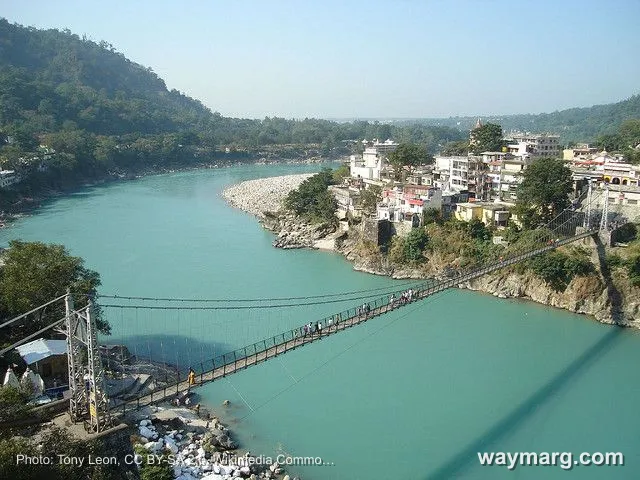
Lakshman Jhula, Rishikesh: Where Lakshmana Crossed the Ganga
Lakshman Jhula is one of the most photographed landmarks in Rishikesh, and the story behind its name is older than any bridge that has ever stood here. Tradition holds that Lakshmana, Rama's younger brother, crossed the Ganga at this exact point on a rope woven from jute -- a far humbler crossing than the one his brother is said to have made elsewhere in the epic. The two crossings are usually read as a deliberate contrast: where Rama's own river-crossing (most famously the causeway to Lanka, told at length in our Ramayana sites coverage) is an act of strategy and divine engineering on a vast scale, Lakshmana's jute-rope crossing at Rishikesh is remembered as an act of personal penance and devotion -- quiet, solitary, and unassisted, undertaken on foot with nothing but a rope strung hand-to-hand across the current. It is the kind of story that doesn't need grand stakes to matter: the point of telling it for centuries wasn't the difficulty of the crossing, but the humility of making it at all. That memory is why the ford has carried Lakshmana's name for as long as anyone has been recording it, long before iron and cable ever reached this stretch of the Ganga.
- State: Uttarakhand (Rishikesh, on the Ganga)
- Key legend: Lakshmana's penitential crossing on a jute rope
- Bridge rebuilt: 1927–1929, opened to traffic April 1930
- Funded by: Rai Bahadur Shewpershad Tulshan, in memory of his father Surajmal Jhunjhunwala
- Current access: Original bridge closed since 2019; Bajrang Setu's central deck in use, glass walkway pending formal opening -- verify locally
- Suitable for: Landmark/photo stop, ghat walk, and a natural pairing with Ram Jhula and central Rishikesh
A Crossing Remembered Long Before It Was Built
The jute-rope crossing predates any built structure at this site by, in the tradition's own telling, millennia -- the site was already a named, recognised ford tied to Lakshmana's story for generations before anyone attempted to span it permanently. The Ganga here runs fast and narrow between the Tapovan bank (in what is now Tehri Garhwal district) and Jonk on the opposite shore (Pauri Garhwal district), which is likely exactly why this particular stretch was chosen for a rope crossing in the first place -- narrow enough to attempt, dangerous enough that doing it on foot was itself the point of the austerity.
The Bridge: Washed Away, Rebuilt, and Rebuilt Again
The first real bridge at this site was a gift from the Marwari businessman Surajmal Jhunjhunwala, a 284-foot span that stood until the great flood of October 1924 tore it from its moorings. It was Jhunjhunwala's son, Rai Bahadur Shewpershad Tulshan, who paid to rebuild it on the same site in his father's memory -- the new structure, a 450-foot iron suspension bridge built by the Public Works Department between 1927 and 1929, opened to traffic on 11 April 1930. A plaque on the bridge records both the dedication and an unusual promise: that no toll or tax would ever be charged for crossing it, a pledge that held for nine decades until the bridge itself was closed rather than taxed.
That closure came in 2019, after decades of load the 1929 structure was never engineered for -- it was designed for foot traffic and the occasional cart, and ended up carrying motorcycles, scooters, and the crowds of a town that had grown into one of India's busiest pilgrimage and yoga destinations. A structural assessment found the cables and deck unsafe to continue bearing that weight, and the bridge was closed to all traffic, first restricted to pedestrians only and then shut entirely as deterioration continued. It remains standing -- a landmark to view from the ghats on either bank, not one to walk across.
Why Rishikesh Has Two "Jhulas"
Visitors new to Rishikesh are often confused by the fact that the town has two similarly named suspension bridges: Lakshman Jhula, upstream and tied to the Lakshmana legend, and Ram Jhula, a few kilometres downstream and associated by name with Rama himself. They are separate structures serving separate stretches of the riverfront, built in different eras for different purposes, and they are not interchangeable in a visitor's plan -- Ram Jhula remains open and fully functional for both pedestrian and light traffic, anchoring the ashram cluster around Swargashram and Parmarth Niketan on its eastern bank, while Lakshman Jhula's bridge itself is the closed, legend-bearing landmark described above. Many day plans for Rishikesh end up covering both, precisely because they anchor two different clusters of ghats, temples, and markets along the same river.
Visiting Today
With the original bridge closed, most of what draws visitors to Lakshman Jhula now is the surrounding cluster rather than the crossing itself: the thirteen-storey Tera Manzil (Trimbakeshwar) temple rises directly beside the old bridge on the western bank and is generally open to visitors through the day, roughly 6 AM to 9 PM, with each of its thirteen floors dedicated to a different deity -- it's worth the climb for the river view from the upper levels alone. The lanes on both banks are dense with shops selling rudraksha malas, brass idols, and Himalayan trekking gear, and the ghats themselves stay active with bathers, sadhus, and the occasional cow well into the evening regardless of the bridge's own status.
When to Go
Rishikesh's Ganga aartis are the main scheduled draw in the area and are worth timing a visit around: the evening aarti at Parmarth Niketan, near Ram Jhula, is usually held around sunset -- roughly 6 PM in winter and closer to 6:30–7 PM in the summer months -- and the aarti at Triveni Ghat, further downstream near the town centre, follows a similar sunset schedule with a larger, louder crowd. Arrive 20–30 minutes early at either to get a seated spot on the ghat steps. The International Yoga Festival, held at Parmarth Niketan each March, is the single busiest week of the year for the whole riverfront, Lakshman Jhula's lanes included; outside of that week and the Kumbh-adjacent years, weekday mornings are noticeably calmer than weekend afternoons, when day-trippers from Haridwar and Dehradun fill the ghats.
Getting There
Lakshman Jhula sits at the northern end of Rishikesh's riverfront, roughly 5 km from the town's railway station and bus stand near Triveni Ghat. Ram Jhula is the natural next stop -- about 2–3 km downstream by road, or a flatter, shorter walk along the river paths on either bank if you're coming from the ghats directly, making the two bridges an easy half-day pairing on foot or by a short auto-rickshaw ride. From Ram Jhula, Parmarth Niketan and the Swargashram ashram cluster are immediately on the eastern bank, and Triveni Ghat is a further 2–3 km south, closer to the main town. Most visitors treat Lakshman Jhula as the first or last stop on a loop that also covers Ram Jhula, the ashrams, and Triveni Ghat in a single day along the river.
Ready to plan your trip?
Build a day-by-day itinerary with WayMarg — explore routes, nearby food and stays, collaborate with family, and export your trip. No sign-up needed.
Explore the Ramayana Trail Guide →