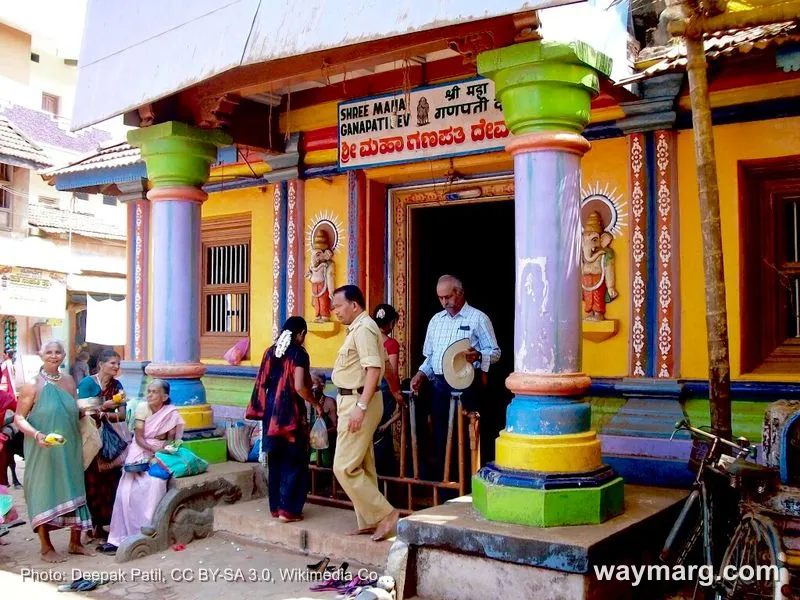
Gunavanteshwara, Karnataka: Beside Idagunji's Ganesha
Gunavanteshwara's fragment comes from the same furious moment at Gokarna that created the whole Pancha Kshetra group: when Ganesha's trick stranded Shiva's Atma Linga in the ground and Ravana tore at it trying to pull it free, the casing's lead seal came away and landed here at Gunavante village, forming the Vamdev Linga. The complete myth -- why Shiva gave Ravana the linga, and how Ganesha's disguise as a herding boy stranded it -- is told in full in our Gokarna Mahabaleshwar guide.
Worth a plain note for anyone trying to pin this site down precisely: its confirmed Google listing carries a different name, "Shri Shambhulingeshwara Temple," rather than the legend's own "Gunavanteshwara." The two are almost certainly the same shrine under a local devotional name and a more formal one -- Shambhulingeshwara is itself a common epithet for Shiva used at many unrelated temples -- but we haven't found independent, field-confirmed documentation that ties the two names to one identical structure, so we flag it rather than assert it as settled fact.
- State: Karnataka (Honnavar taluk, Uttara Kannada)
- Distance from Honnavar: ~10 km; ~45-50 km from Gokarna
- Neighbour: Idagunji Mahaganapati temple, roughly 1 million visitors/year
- Best months: November–January
- Minimum time: 45 minutes (longer if pairing with Idagunji)
Why Pilgrims Pair It With Idagunji
Gunavanteshwara sits in the immediate shadow of a far larger pilgrimage draw: the Idagunji Mahaganapati temple, an independently famous Ganesha shrine dated to roughly the 4th-5th century CE that pulls an estimated one million devotees a year on its own, entirely apart from the Pancha Kshetra circuit. That pairing matters practically, not just geographically -- most people who make the trip out to this stretch of coast are coming for Idagunji's Ganesha first, and treat the quieter Shiva shrine nearby as a short add-on rather than the primary reason for the detour. For a traveller following the Atma Linga circuit specifically, it's worth knowing the reverse is also true: nearly all the infrastructure in the immediate area (parking, food stalls, local guides) exists to serve Idagunji's crowds, so plan around Idagunji's rhythms (festival days like Ganesh Chaturthi, Sankashti Chaturthi, and Ratha Saptami draw its heaviest footfall) rather than Gunavanteshwara's own, much quieter calendar.
Beyond the Temple
Gunavante village is also locally known for a water tank used for bathing and swimming, unrelated to either shrine's religious significance, set against the lush Western Ghats coastal belt that runs down to the Sharavathi river's outlet into the Arabian Sea near Honnavar.
Visiting Today
As with Dhareshwar, there's no confirmed on-site accommodation at Gunavanteshwara itself -- Honnavar, about 10 km away, is the practical base, and it also has reasonable connectivity if you're combining this stop with Idagunji and the rest of the Pancha Kshetra circuit. There's no formal seva-counter or ticketing system here comparable to Gokarna or Murudeshwar; arrangements for any special puja are made directly with the temple's priests.
When to Go
Pradosha observance days and Maha Shivaratri are the busiest at Gunavanteshwara itself, though the crowd is modest compared with Gokarna's own Shivaratri night. If you're timing a visit around Idagunji instead, Ganesh Chaturthi (typically August/September) brings by far the largest crowds to the area as a whole.
Getting There
Gunavanteshwara sits roughly 45-50 km south of Gokarna and about 20-25 km north of Murudeshwar, making it a natural midpoint on a road circuit of the Pancha Kshetra sites. Honnavar, the nearest town, sits on National Highway 66 and has rail connectivity on the Konkan line.
Ready to plan your trip?
Build a day-by-day itinerary with WayMarg — explore routes, nearby food and stays, collaborate with family, and export your trip. No sign-up needed.
Plan My Trip →