Murudeshwar, Karnataka: The Casing That Became Its Own Shrine
Murudeshwar's share of the story goes back to the moment Shiva's Atma Linga fused into the ground at Gokarna and a furious Ravana tore at it trying to pull it free. The cloth that had covered the linga on its journey came away in his hands and flew from him, landing on Kanduka Hill here on the Arabian Sea coast -- becoming the Mrideshwar Linga, kept below ground level in the temple's garbha griha to this day. The fuller version of how it got there, including Ganesha's disguise and the trick that stranded the linga at Gokarna, is told in our Gokarna Mahabaleshwar guide.
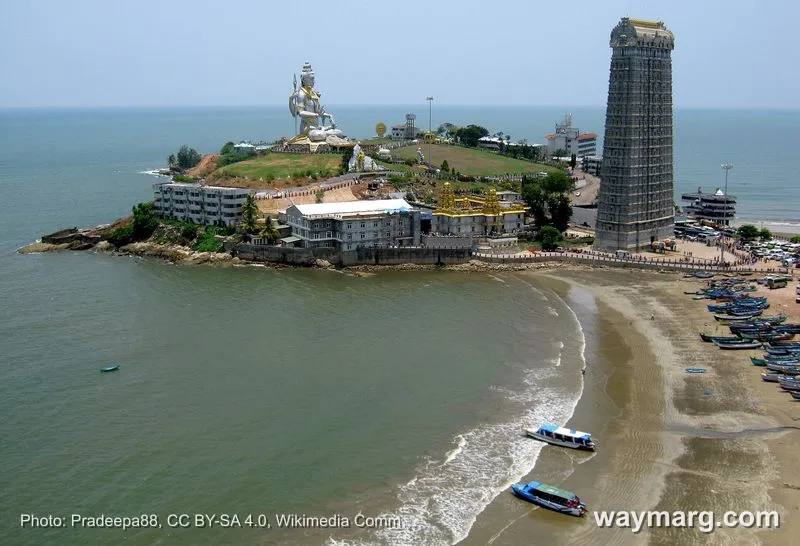
What makes Murudeshwar unlike the other four Pancha Kshetra sites is everything built on top of that legend since. The hill above the ancient shrine now carries a 123-foot (37m) Shiva statue and a 237.5-foot, 20-storey Raja Gopuram with a viewing lift -- both funded by Murudeshwar-born businessman R.N. Shetty (1928-2020), whose own father had been the temple's hereditary administrator before him. Shetty built a civil engineering and construction fortune (RNS Infrastructure, Naveen Hotels, Murudeshwar Ceramics and Power) over four decades and poured a share of it back into the town where he was born, turning a modest coastal shrine into Karnataka's most tourist-crossed pilgrimage stop.
- State: Karnataka (Uttara Kannada district)
- Statue: 123 ft (37m) Shiva -- third tallest Shiva statue in the world, after Nathdwara's Statue of Belief (112m) and Nepal's Kailashnath Mahadev (43.5m)
- Gopuram: 237.5 ft, 20 storeys, built 2008, with a paid viewing lift to the top
- Patron: R.N. Shetty (1928-2020), businessman and Murudeshwar native
- Best months: November–January
- Minimum time: 2 hours, including the gopuram lift queue
Correcting a Common Overstatement
Murudeshwar's statue is widely advertised online, and sometimes still by older guidebooks, as "the world's tallest Shiva statue" -- that claim stopped being accurate once taller statues were completed elsewhere in India. By current published height lists, it's the third tallest: Nathdwara's Statue of Belief in Rajasthan (112m, completed 2022) and the Kailashnath Mahadev in Bhaktapur, Nepal (43.5m) both stand taller. At 37m, Murudeshwar still ranks comfortably inside the world's top dozen Shiva statues and remains the tallest on Karnataka's coast -- a genuinely striking landmark, just not the outright record-holder it's often still described as.
A Shrine Beneath a Statue
The contrast at Murudeshwar is deliberate and striking in person: the actual object of worship, the Mrideshwar Linga, sits below ground level in a modest sanctum, visible mainly to seva-karta devotees, while the 37-metre statue and the 20-storey gopuram tower directly above and around it. The gopuram's lift carries visitors to an observation deck near the statue's base for views across Murudeshwar's rocky peninsula and the Arabian Sea -- a modern viewing platform grafted onto what is, underground, still a centuries-old pilgrimage shrine.
More Than One Legend on the Same Hill
The statues and relief carvings scattered across the complex go well beyond the Atma Linga story: a Sun Chariot installation, a scene of Krishna delivering the Bhagavad Gita's teaching (the Geetha Upadesham) to Arjuna, and a depiction of the Ganga's descent to earth all share the grounds, alongside a small museum, the Bhukailasa Cave, built into the hill beneath the statue. Walking the complex ends up closer to an open-air gallery of Hindu mythology than a single-deity temple visit -- part of why Murudeshwar now draws general tourists in roughly equal numbers to pilgrims.
Visiting Today
Traditional attire is preferred for sanctum entry, as at the other four sites, though the statue grounds and gopuram themselves see far more casual tourist dress than the temple proper. Lift tickets for the gopuram viewing deck are sold at temple-authorised counters on site; buy there rather than from touts near the parking area, who sometimes offer unsanctioned "photography packages" or guide services at inflated prices. Expect meaningful queues for the lift itself, separate from any darshan queue, especially through the December-January peak season and on weekends.
When to Go
Maha Shivaratri draws large crowds here too, though nothing on the scale of Gokarna's own Shivaratri gathering a short drive south. November through January remains the most comfortable weather window for both the temple and the statue-and-gopuram visit; arrive early morning to beat both tour-bus traffic and the worst of the lift queue.
Getting There
Murudeshwar Railway Station, on the Konkan Railway line, sits about 12 km from the temple, with long-distance trains including the Netravati and Matsyagandha Express stopping here -- a genuinely useful alternative to road travel if you're routing through the Pancha Kshetra circuit by rail. By road, Murudeshwar is roughly 20-25 km from Gunavanteshwara and Idagunji to the south, and roughly 65-80 km from Gokarna, making it a natural midpoint stop on a two-to-three-day circuit of all five sites.
Ready to plan your trip?
Build a day-by-day itinerary with WayMarg — explore routes, nearby food and stays, collaborate with family, and export your trip. No sign-up needed.
Plan My Trip →